

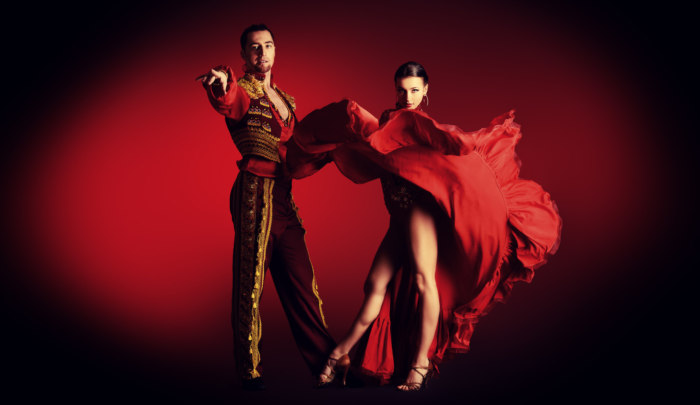
The national dance for the Dominican Republic is the merengue. In Haiti, there is a dance called meringue that may be related to the merengue. Also, Venezuelan, Afro-Cuban and othere Latin American dances and music have influenced this dance. It is rumored that it originated from slaves mimicking the French minuet. However, to this day, historians still argue the country of origin. Over time, these slaves added an upbeat and a hop and skip to make the dance more lively. There are two prominent stories to how the dragged feet movement came about within this dance. The first, is that it was to the African slaves dragging their feet while chained together. This later became a strong representation of community recognition. The other claims the dance depicted a war hero who had a limp, so the dancers honored him in mimicry.
While, this dance gained great popularity in the late 1800s, the rumba was decreasing in status. The exact origin of merengue music is unknown. Additionally, musical instruments frequently used for the music are the accordion, bass guitar, saxophone, tambora drum, trumpet, trombone and tuba. Also, the music is counted 1,2,1,2 or 1,2, 3,4, often in 2/4 or 4/4 timing using a marching style step. Consequently, dancers do one weighted step per beat of music. Finally, in the mid nineteenth century, Rafael Trujillo, the leader of the republic declared it the national dance.
Merengue Dance Performances
USA Merengue Couple – Segundo Campeonato Mundial de Baile
Learn Merengue DVDs
Elena Grinenko & Paul Barris
Suavemente by Elvis Crespo & Pitbull
Gabriela Julie & Lazaro dance
Ritmo de la Noche
El Baile del Beeper
Bailando por el mundo
Shirley Alvarez & Ricardo Grandados Costa Rica
Merengue Music
The music is in 2/4 or 4/4 timing and often divided into two or three sections. In addition, common musical instruments include: an accordian, guitar, sax, metal scaper and two drums. However, some contemporary groups include congas, timbales and keyboards as well.
Suavemente
Merengue song by Elvis Crespo
Mi Primer Millon
Song by Los Toros Band
Esa Muchacha
Song by Los Hermanos Rosario
Rabiosa
Merengue song by Shakira
Contemporary Merengue Dance

Originally, people danced the merengue in a circle at arms length and little or no hip action. In contemporary context, this partner dance spread in the United States when the social ballroom dance studios began teaching it in as an American rhythm (Latin) social dance. Ballroom dance studios taught it along with the other Latin dances including Cha Cha, Rumba, Samba, Salsa, Bachata and Mambo. The merengue was danced with one leg straight accenting beats one and five in its early ballroom history. However, today it is danced like the cha cha, mambo and rumba using Cuban motion. Its popularity increased along with the Salsa in the 1970’s and spread from dance studios to Latin dance venues and nightclubs.
The contemporary version uses all the social ballroom dance positions and handholds. This includes closed basic, one-hand, two-hand, handshake and cross hand position. The basic step is usually taught as a side-close, side-close, but it also moves forward, backward and circular plus partners moving toward each other and away. Almost every imaginable movement that is used in swing, hustle and nightclub dancing is used in merengue. Some of these patterns include wraps, cuddles, walk arounds, underarm turns, pivots, hammerlocks and many more variations of dance elements.
Dance Characteristics
The upper body remains level with sway seldom used in merengue. In addition, this emphasizes the hip and knee action necessary to accomplish Cuban motion. Also, the ribcage and hips work in synchrony to achieve a rhythmic Cuban action. Additionally, the ribcage initiates the movement and the hip follows. In most styles of this dance, the footwork is ball-flat. Some Latin dance teachers that teach a forward walk with heel leads where the person walks forward in a circular movement.
In the United States and especially in Southern California, the merengue has been very popular in the last few decades. Accordingly, San Diego, California has a large, flourishing Latin dance community with a great variety of Latin and Salsa dance venues. Also, the Latin dance venues include Salsa, Bachata, Cha Cha and Merengue in their music selections. In addition, there are a considerable number of dance studios that offer American-style Latin dance instruction. For example, many dance studios offer dance lessons in the salsa, bachata, cha cha, samba, mambo, rumba, bolero and merengue.
Merengue Basic Dance Lesson
The merengue is not difficult to learn. In fact, it is a great dance genre for beginners due to its simplicity. Essentially, it is a walking dance with hip movement. The basic step can be done in place using marching techniques or forward, back and sideways. Generally, the basic consist of four walks back followed by four walks forward. Therefore, the pattern goes apart for four beats and then together for four beats. There is a basic step pattern where the couple move left for four beats then right for four beats.
How to do the forward-back step!
Basic Step by Ernesto Palma & Crystal Rodriquez
Resources
- Spinditty List of the Top 10 Best Merengue Songs for Beginners and Intermediate Dancers
- Playlists.net Top 100
- Howcast.com How to do the basic step – merengue dance
- Britannica.com Merengue Dance
- Steppingoutstudios.com
- Ernestopalma.com
- Wikipedia Merengue Music
- DanceTime’s Different Dance Styles